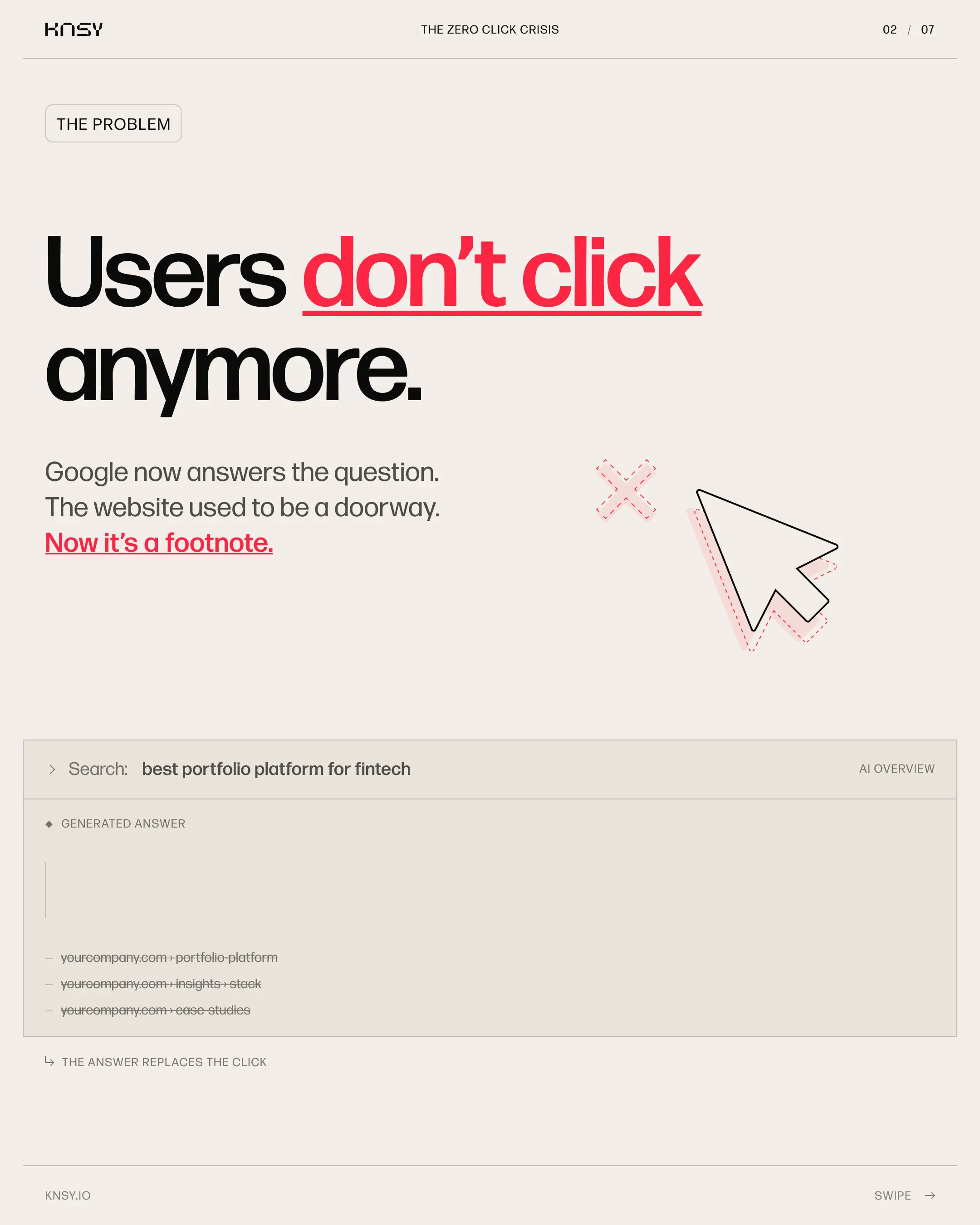

Search used to have a simple contract. Someone types a question, Google shows a list, they click the most relevant result, they land on your site. That contract is broken.
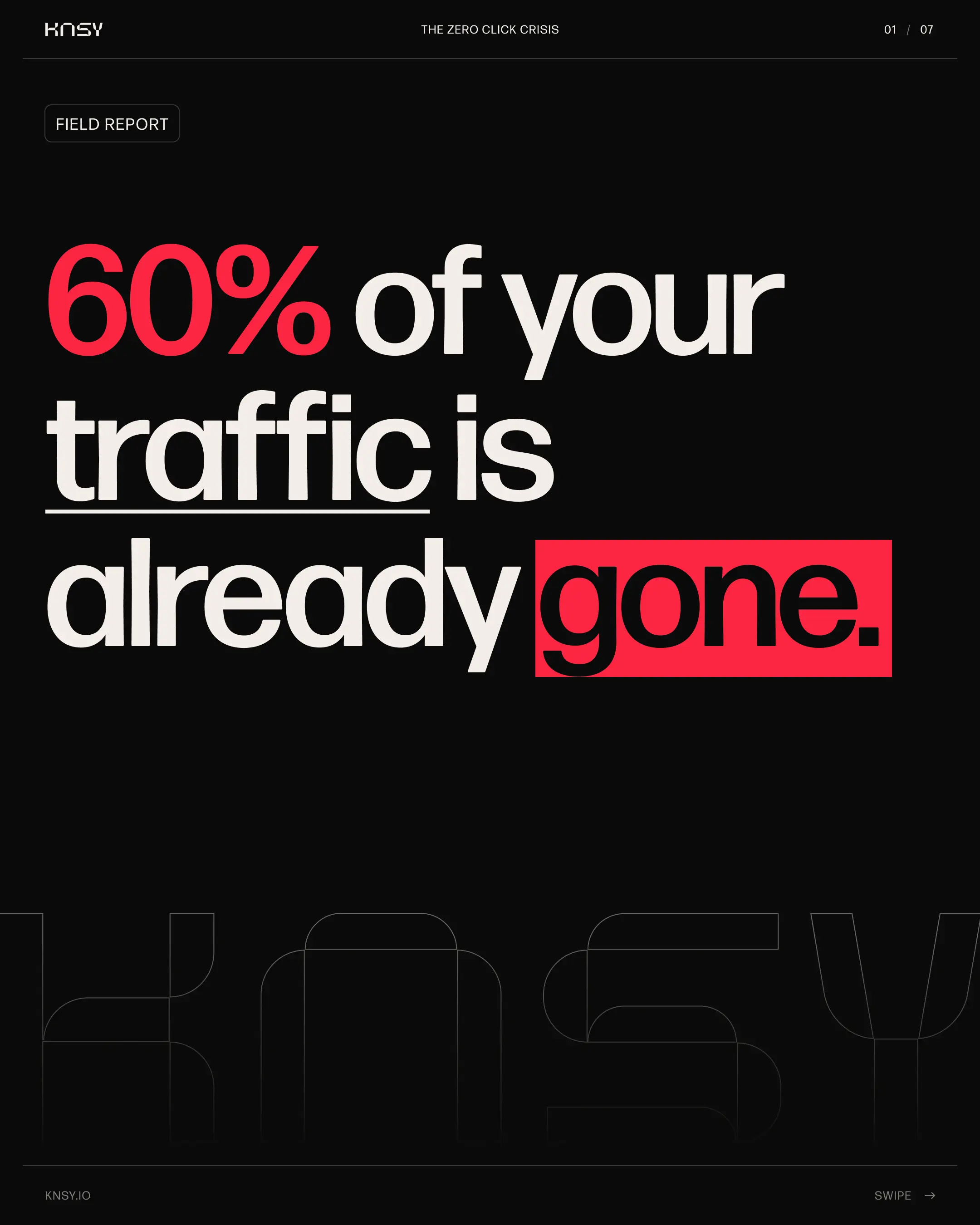
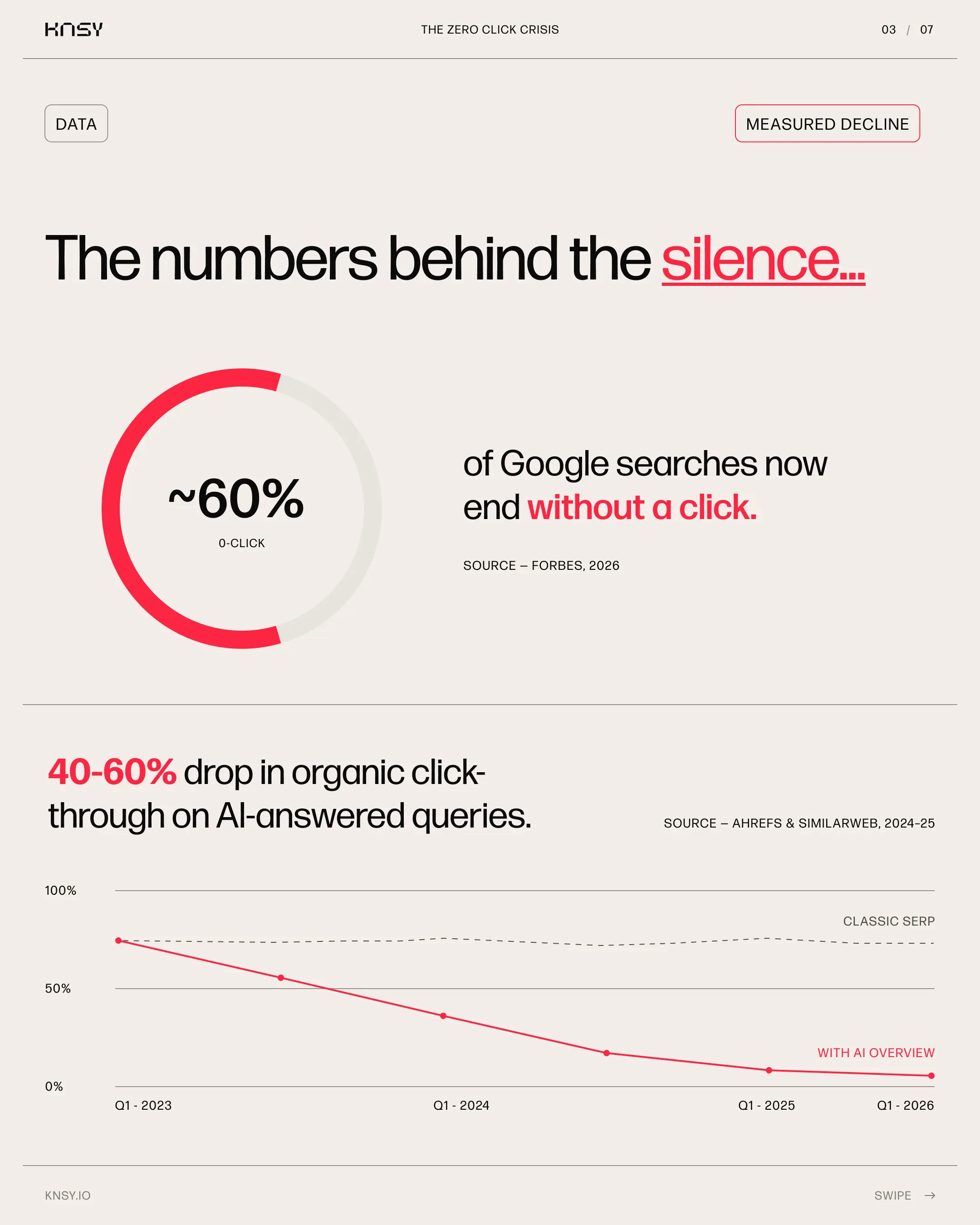
Roughly 60% of Google searches now end without a single click.
Not because people didn't find what they were looking for but because Google answered the question before they ever had to leave. An AI Overview appears at the top of the page, synthesises the most relevant information from across the web, and the user exits satisfied. Your site was never visited. You may have even been the source. This is the zero-click crisis. And most businesses have no idea it's happening to them.
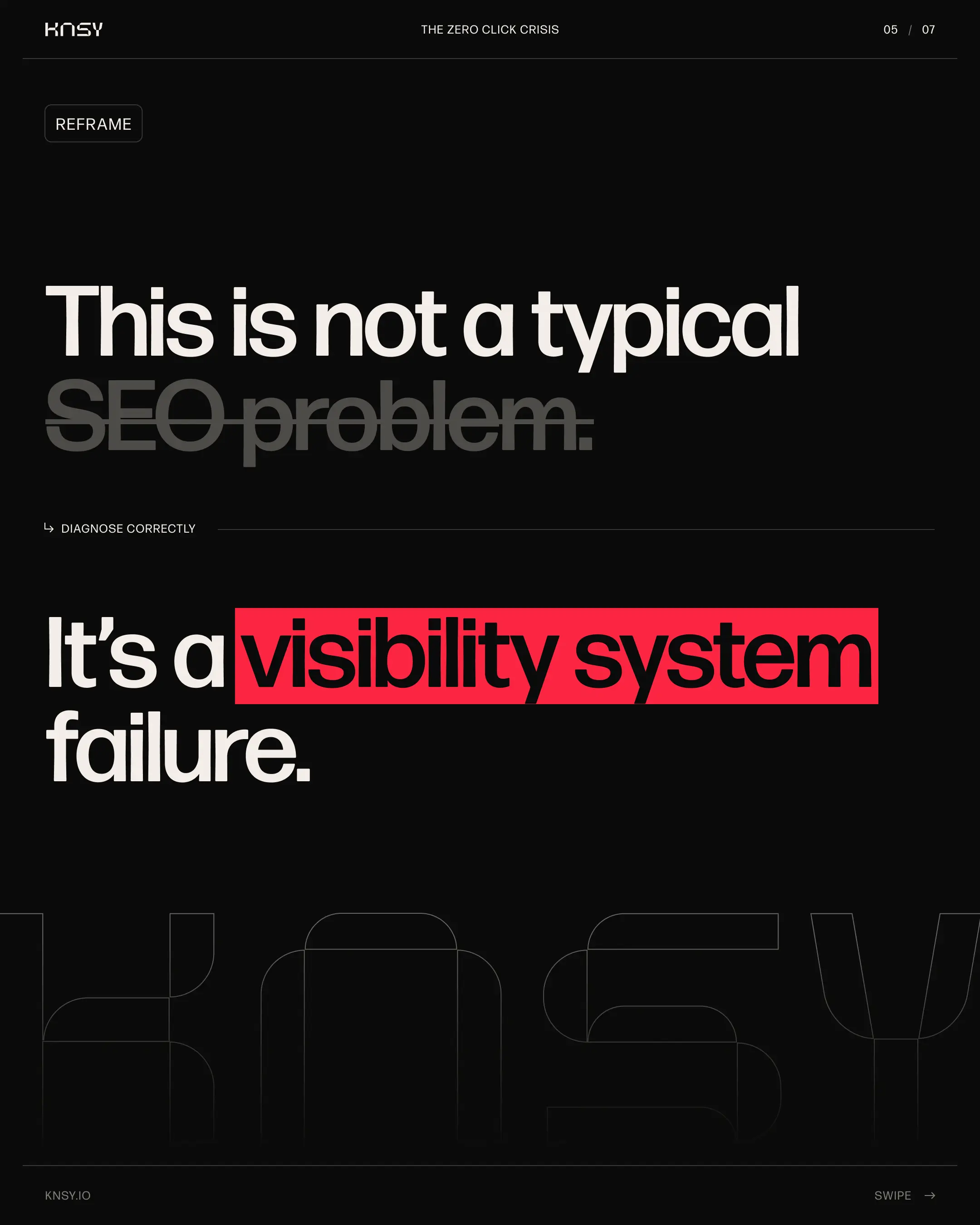
When traffic drops, the instinct is to look at SEO. Check rankings, audit backlinks, refresh content. Now that's not wrong, more incomplete. Because the shift that's happening right now isn't just a search engine optimisation problem. It's a visibility system failure.
The search engine is no longer a directory. It's a destination. Users ask questions and get answers. Google, ChatGPT, Claude, Perplexity etc. These platforms are now the first and often final point of contact between a buyer and a decision. If your brand isn't present in those answers, you don't exist in that moment.
And that moment is the one that matters.
We run visibility reports for clients across search and AI surfaces. We're not just tracking where brands rank organically, but whether they appear inside AI Overviews, whether LLMs recommend them when a buyer asks a relevant question, and how exposed they are to zero-click behaviour eating into their traffic.
What we find, consistently, is a gap most businesses aren't even measuring.
Take a recent report we ran for a crypto payment gateway operating in the UAE. Invisible in organic search for their primary keyword. Absent from Google's AI Overview on every tracked query. Mentioned zero times across six separate LLM visibility checks. Their closest competitor, by contrast, ranked ninth organically and scored more than double their overall visibility health score.
The business was operating, but in the places their buyers were actually asking questions, they weren't there. Not penalised. Not outranked. Just absent.
That's the new version of being invisible.
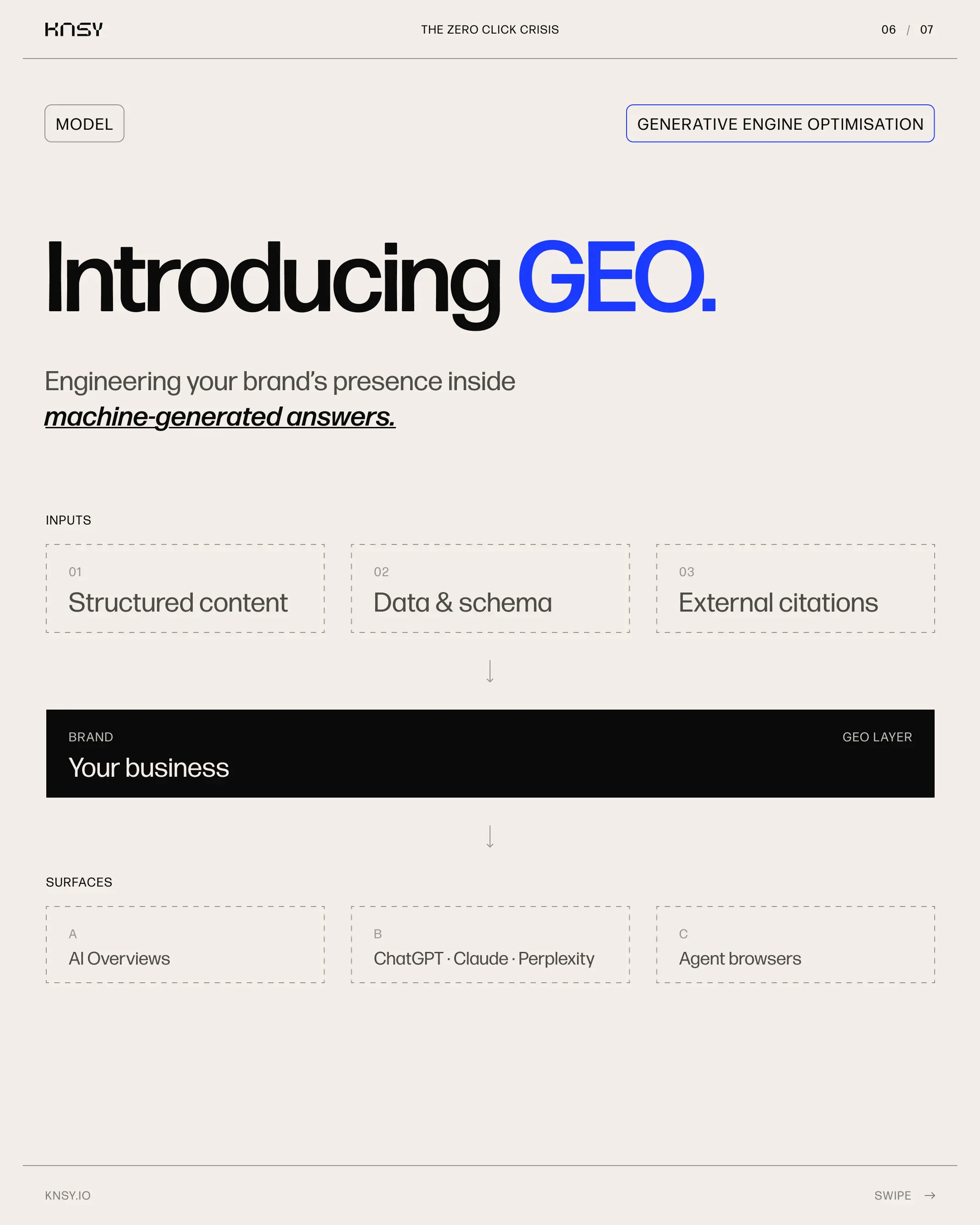
Generative Engine Optimisation is the discipline of engineering your brand's presence inside machine-generated answers. Where traditional SEO focuses on ranking in a list of links, GEO focuses on being cited, referenced, and recommended by AI systems when they construct their responses.
The inputs are different. Structured content, clean data architecture, schema markup, external citations, authoritative signals — these are what machines use to decide whose voice gets included in a synthesised answer. Getting this right means showing up inside AI Overviews, inside ChatGPT's recommendations, inside Perplexity's citations, inside the agent browsers that are beginning to replace traditional search entirely.
Getting it wrong means being referenced without being visited, or worse, being ignored entirely while a competitor fills the gap.
We didn't start offering GEO because clients were complaining. Traffic hadn't fallen off a cliff for most of them. The problem was quiet, that is why it's dangerous.
The businesses that will feel this most acutely in two or three years are the ones doing nothing about it now. The shift is gradual enough that it doesn't trigger alarm bells. But the compounding effect of being absent from AI surfaces while competitors establish presence inside them is significant. Citation patterns in LLMs are not neutral, they reflect what the model has been exposed to, what's been structured for it to understand, and what external sources have validated. Getting in early matters.
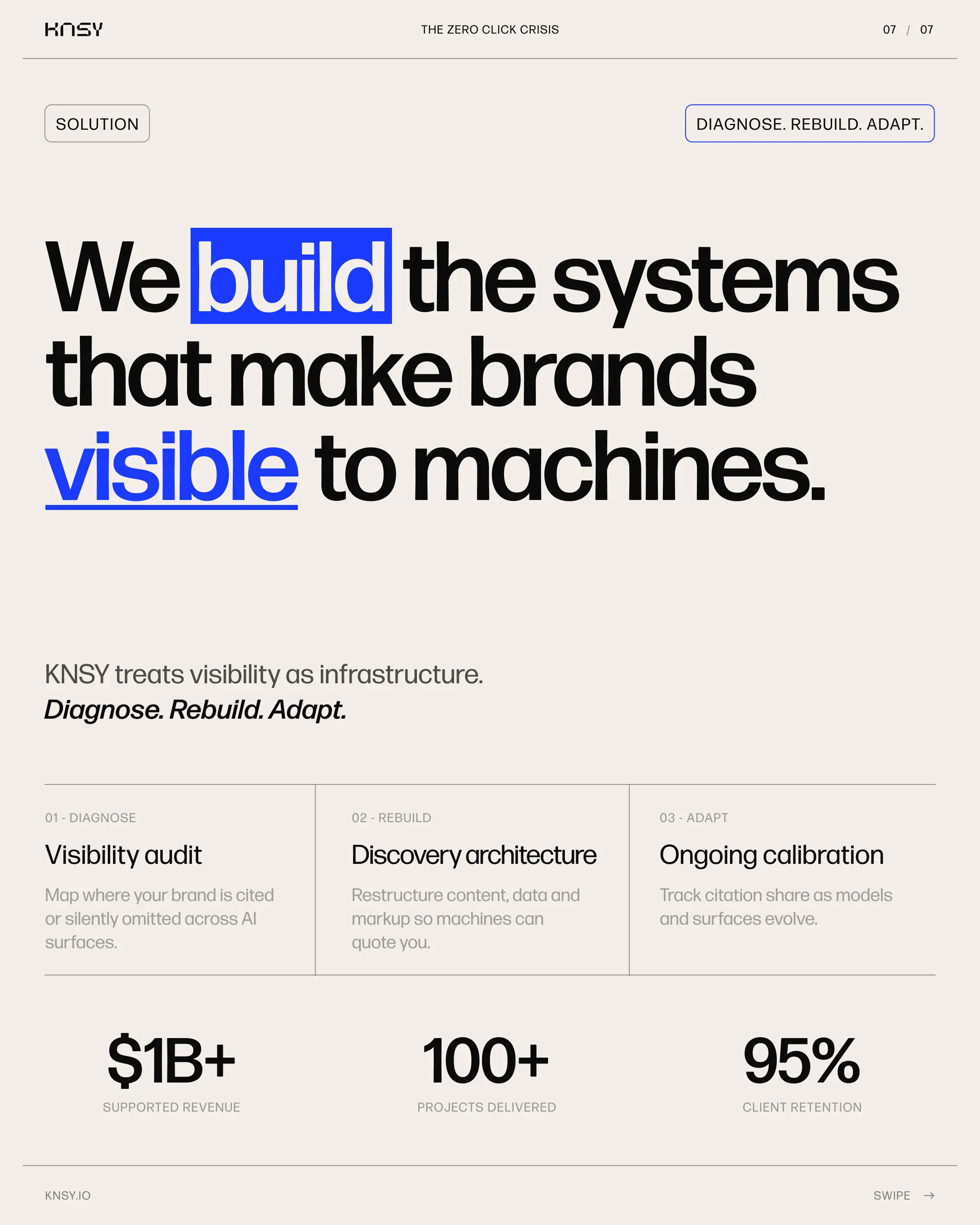
We now offer GEO as both a standalone system and a bolt-on to existing brand and digital work. The entry point is a structured diagnostic that maps where a brand sits across organic search, AI Overviews, and LLM recommendation surfaces, benchmarked against competitors. We call it a 'Visibility Report'. From there, we rebuild what needs rebuilding and calibrate as the landscape evolves.
Because it will keep evolving. That much is certain.
Visibility used to mean ranking. Then it meant being clicked. Now it means being the answer.
The brands that understand this shift early and invest in being structured, citable, and present across the surfaces where decisions are being made will compound their advantage over the next few years in ways that will be very difficult for slower movers to close.
––––––––––––
If you want to know where your brand stands, we offer a free 7-day Visibility Intelligence Report — a structured diagnostic across organic search, AI Overviews, and LLM surfaces, delivered as a systems report, not a slide deck. Get in touch now.